
Having travelled 11,052 miles through 11 western states over eight weeks, I thought I’d reflect on what I’ve heard and the perceptions gained. Reflecting my consultancy career, this is akin to an interim report.
I’m drawing on over 120 conversations with friends, family, and strangers I met out west. No one was hesitant to speak and share their thoughts. Some were pleased to unburden themselves of the tension they held. I positioned myself as neutral, introducing myself as ‘John from Scotland’. The latter was enticing – I often got asked about Scotland, where to visit, or to be told about a connection, clan, trip or family. I listened, not advocated – the only time I changed this tack was to observe that the best thing to come out of Edinburgh is the road to Glasgow. My western route on the map below.

Four inter-related themes emerged.
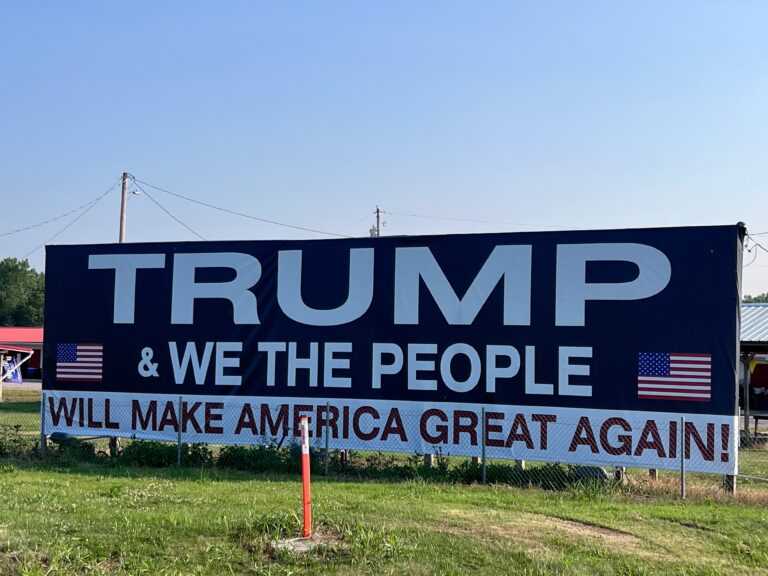
First, I recall the observation by Shelby Foote, the renowned Civil War historian, that before 1860 it was grammatically said that the United States are; after 1865, it was the United States is. What comes across today is that the United States are. This will not be a surprise to you, nor was it to me. However, the depth and breadth of polarisation and divisiveness is increasing – around politics, economics, and culture. Aligned to this pluralism is the decline in civic society – more of ‘me’ than ‘we’. Rural areas were particularly critical of cities, their drain on resources and dependence on government. This came across in the sloganising of those on the right – while ‘Let’s go Brandon’ was ubiquitous, the nearest I saw to a balancing view was on a road barrier in Idaho.

Therefore, the twain shall never meet. I heard time and again that friendship groups comprise only those of the same view and, if there is someone of a different political, economic, or cultural inclination, then there’s tacit agreement not to speak about any differences. Even this type of relationship was certainly the exception, and I heard more often about someone being cancelled by a long-term friend or, indeed, a family member because of different points of view. A man who had been cancelled by his whole family went through a packet of tissues as he unburdened himself in our conversation. This inability to have a generative conversation with someone who holds different views to yourself saddens me – I had many conversations with many old friends who hold a range of perspectives.

Third, social media was universally cited as a significant contributory factor in how people get their information and form their views. I heard many conspiracy theories – all from the right. A rational person would regard them were all as idiotic, but they are sincerely believed by those who shared them with me. I always asked where I could learn more about these stories, and was pointed to websites, podcasts, and hearsay. I didn’t pass an opinion on what I heard, rather searched for evidence so I could learn more. People get their views formed, or reinforced, by their friendship groups, so the homogeneity of these relationships causes people to keep digging. Social media also reaffirms their views with ‘news’ fed to them. Social media must take a lot of the responsibility for this polarisation, but it continues to build up disciples, as I found out when I saw a steady stream of people posing in front of the Meta/Facebook and Apple signs at their Silicon Valley HQs. It struck me that these were the new religions, especially as I toured Silicon Valley on a Sunday morning.

But there is hope. While I often heard about the tipping point on climate and civil war, the more common view was the expectation that a more positive future lies with kids. Even the doomsters shared a view that they had hopes for the next generations – whether those entering schooling or already in it. This optimism is ironic, given the views I heard from the right that teachers are too liberal and that Covid has shown that kids are being taught deviant views, especially the university-level concept of critical race theory (CRT). When I heard this in conversations, I always asked where I could see the curriculum or where I could learn more about this teaching. The response to my enquiries was always that this is what they’ve heard. Politicians are, therefore, now campaigning to get control of local school boards in order to shape the curriculum away from CRT and similar teachings. It’s also ironic that, while there is a willingness to discuss significant cultural and historic issues that affect others, e.g. the Holocaust, there is less willingness to explore similar issues closer to home, e.g. slavery and Native American genocide.

These are initial reflections from out west. Personally, I’m optimistic, if for no other reason than from my own experience in conversations. Nothing really surprised me, though some of the conspiracy theories were new. People need to try listening, to enquire, not to advocate. Yes, some views came across as loony and pretty uninformed, but they were sincerely held views.
President Biden called out the MAGA right during my travels and, while I initially wondered about the merit of this approach, the non-MAGA actors need to join in the hardball game, instead of playing softball. After all, it was Steve Bannon who observed about the Mueller enquiry into Russian collusion in the 2016 election, ‘Never send a marine to do a hitman’s job’. I’ll see what I hear in the Midwest and upper South on the next leg of the road trip.

19 Responses
Shelby Foot’s observation is apposite. Your observations are as well, and I enjoyed reading them. The West/NorthWest is not a part of the US that I know well and what acquaintance I had is decades out of date. So thanks for the updating. Historically, the West was never integrated with the other states pre Civil War and it certainly seems to be diverging now. One hears from friends in California of people upping sticks and moving to Idaho and Montana to escape what they see as the “wokeism” takeover. It will be interesting to contrast your themes from the Western journey with conclusions you have after the Upper South and Midwest legs of the your odyssey. I suspect there will be a strong crossover. I shudder at the thought that the Great God “TikTok” might be a main information channel for the MAGA mob. No wonder they take fright at what they are told about CRT (which never existed in a US primary school and never will because of the technical conceptual vocabulary it employs if for no other reason). I’m sure the “1619 Project” gets the same treatment from many public and wannabee public officials. So frightened of facing the truth. It is sad and dangerous when a country turns its face against its own history. Think Putin’s Russia to see where that leads. And of course we have a strong streak of ethno-English “spitfire nationalism” back here in these septic isles as well.
Andrew, thanks for these considered thoughts. I was a bit hesitant to put down some preliminary reflections, but felt that it would help frame my thinking. As I travel the Midwest, I’m getting further dimensions, but not far from what I found out West. More than one conversation has highlighted TikTok as a news source which, given what I’ve been shown, is pretty scary. When I’m told things, I always ask for evidence and, when shown the clips, it’s pretty obvious how many of the views are formed.
I was excited to uncover this site. I need to to thank you for your time for this particularly wonderful read!! I definitely savored every part of it and I have you saved to fav to see new stuff in your site.
Cheers, hopefully you caught up on the other posts too. J
Excellent blog post. I certainly love this website. Keep it up!
Cheers, much appreciated. J
Good post. I learn something totally new and challenging on websites I stumbleupon every day. Its always exciting to read articles from other writers and practice a little something from other sites.
Cheers, much appreciated. J
Hello there, simply changed into aware of your blog via Google, and located that it’s truly informative. I?m going to watch out for brussels. I?ll appreciate if you happen to continue this in future. Lots of other folks shall be benefited from your writing. Cheers!
I would like to thank you for the efforts you’ve put in writing this web site. I’m hoping the same high-grade website post from you in the upcoming also. In fact your creative writing skills has inspired me to get my own web site now. Really the blogging is spreading its wings rapidly. Your write up is a good example of it.
Thanks for sharing superb informations. Your site is very cool. I’m impressed by the details that you have on this blog. It reveals how nicely you perceive this subject. Bookmarked this website page, will come back for more articles. You, my pal, ROCK! I found just the info I already searched everywhere and just could not come across. What a great website.
An fascinating discussion is price comment. I believe that you must write more on this subject, it won’t be a taboo topic but generally persons are not sufficient to talk on such topics. To the next. Cheers
Oh my goodness! I’m in awe of the author’s writing skills and talent to convey complex concepts in a concise and concise manner. This article is a real treasure that deserves all the praise it can get. Thank you so much, author, for offering your wisdom and giving us with such a priceless treasure. I’m truly appreciative!
Appreciating the dedication you put into your blog and detailed information you offer. It’s great to come across a blog every once in a while that isn’t the same outdated rehashed material. Excellent read! I’ve bookmarked your site and I’m adding your RSS feeds to my Google account.
Someone necessarily lend a hand to make critically posts I would state. This is the very first time I frequented your web page and so far? I surprised with the research you made to make this particular post amazing. Great job!
Magnificent goods from you, man. I’ve understand your stuff previous to and you’re just extremely wonderful. I really like what you’ve acquired here, really like what you’re saying and the way in which you say it. You make it enjoyable and you still care for to keep it wise. I cant wait to read far more from you. This is actually a terrific web site.
Hello there, just became alert to your blog through Google, and found that it is really informative. I am gonna watch out for brussels. I will be grateful if you continue this in future. Many people will be benefited from your writing. Cheers!
I’ve been surfing online more than three hours today, yet I never found any interesting article like yours. It is pretty worth enough for me. Personally, if all web owners and bloggers made good content as you did, the web will be much more useful than ever before.
Useful info. Lucky me I discovered your website by chance, and I am stunned why this coincidence didn’t happened earlier! I bookmarked it.